

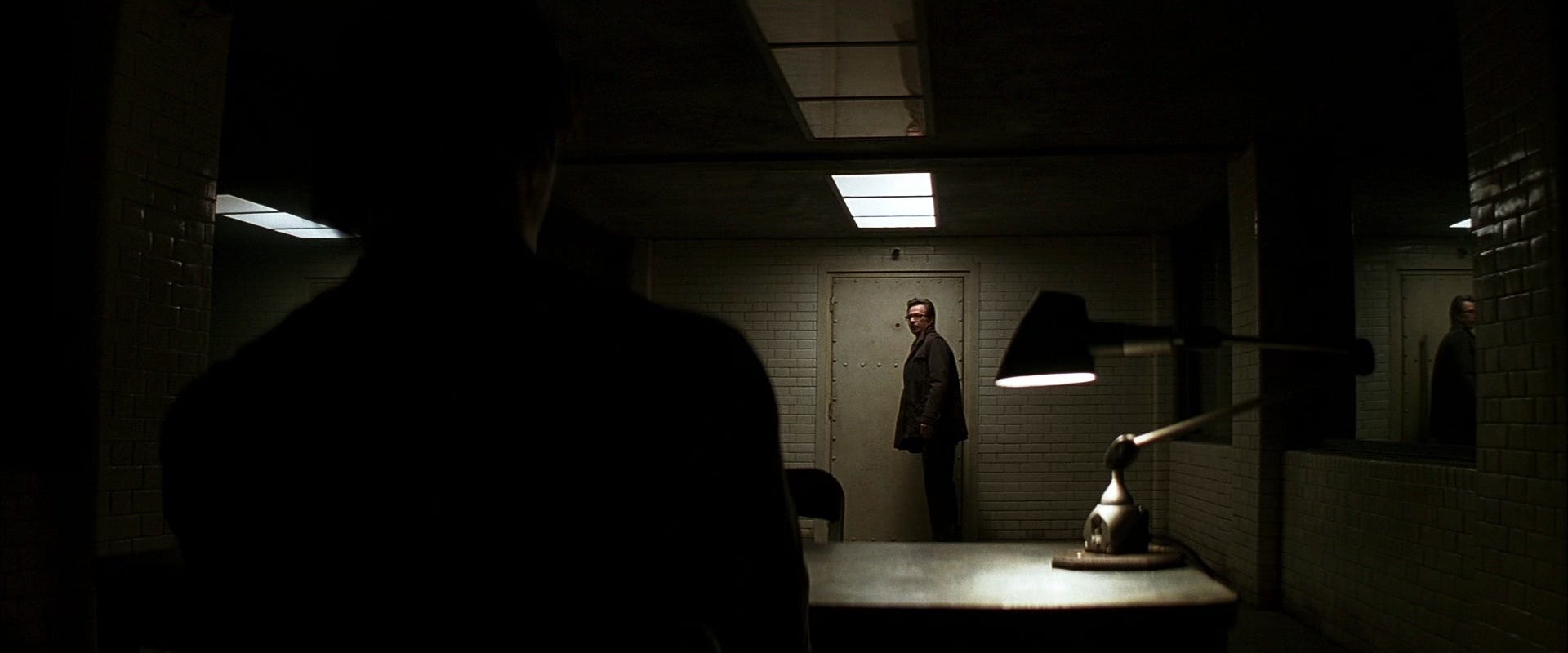
Wally Pfister’s father was a television news producer who spent his career at ABC News covering political conventions, space flights, and the civil rights movement. The elder Pfister moved through history with a camera at his side. Wally grew up understanding that a camera was not just a tool for making things look beautiful. It was a tool for capturing what was actually happening.
He started at eighteen as a news cameraman. Not a cinematographer, not a camera operator on a feature. A news cameraman, running toward things rather than setting them up, reading light in real time because there was no time to do anything else. He did documentaries for PBS. He worked with Robert Altman as a second unit cameraman on Tanner ‘88. By the time he enrolled at AFI and began working his way toward narrative features, he had already spent thousands of hours with a camera on his shoulder. The craft was in his body before he ever thought of it as art.
What turned him toward the art side was a single film. Being There, shot by Caleb Deschanel for Hal Ashby in 1979. A naturalistic, stunning-looking movie that also happened to be a comedy. Light that did not look like light, that felt like it had simply been found. He watched it and understood for the first time that photography could do something invisible and profound at the same time. Caleb became a hero. Then Gordon Willis. Then Conrad Hall. Then Nestor Almendros. He made a point of seeing everything each of them had ever made.
By the time Memento came along and a young Christopher Nolan hired him at the Sundance Film Festival, Pfister had been working for nearly two decades. He was not an overnight discovery. He was someone who had put in 10,000 hours before anyone with real money came calling.
The first read is not a technical exercise
Pfister is precise about what happens when he reads a script for the first time. Instinct, he says, does not kick in. Not yet. The first read is about being an audience member. Is there something here that interests him? Is he entertained? Does he want to see this film?
The analysis comes in the second read. That is when the visual language starts to emerge, when things jump out, when he starts seeing what the film might look like. The mechanical breakdown, the technical preparation, the questions he would write down and bring to Nolan in a list, all of that is the third pass and beyond.
What he is describing is a sequencing of attention. You have to let the story work on you as a story first. If you come to it as a cinematographer from the first line, you are already interfering with the most important information the script is trying to give you, which is whether it makes you feel something.
With the Nolan films, this question was simple. He would read the script and know immediately that he wanted to go to the theater and pay to see the film. That desire, more than any aesthetic consideration, was the real foundation of every collaboration.
Batman Begins, The Dark Knight, and the courage to take risks
Pfister had mixed feelings about his work on Batman Begins. Not about the experience, not about Nolan, but about his own choices. Looking back, he felt he had been playing it cautious. Not taking the risks he wanted to take.
By the time they returned for The Dark Knight, everything had shifted. Batman Begins had been a huge success. The Prestige had followed. There was a fan base, a sense of momentum, a feeling that they could do whatever they wanted. And the IMAX format, which Nolan had been wanting to explore properly, suddenly became possible within the studio system.
Pfister’s response to that freedom was to break the film into visual sections, each with a different flavor. Batman Begins had felt to him like it all looked the same, a consistent warm palette that, however handsome, left no room for the film to change texture as it moved. Dark Knight mixed it up. Different looks for different parts of the story. He wanted variety to serve the narrative’s escalation.
Dark Knight Rises moved in the opposite direction, back toward a more consistent palette. He had learned from Dark Knight what too much variation felt like and pulled back toward coherence. He is not entirely certain he remembers his conceit for every choice anymore. Eight years is a long time. But he knows that the intention was always the same: variety or consistency, whichever one the story required at that moment.
Inception and the soundtrack of a career
Of all the films he was involved in, Inception is still his favorite. The Oscar helps, but that is not the reason. The reason is that he felt, for perhaps the first time, that everything came out on screen the way he wanted it to. The visual language they developed for the film, giving each dream level and each location its own distinct color palette so the audience always knew where they were even when the editing made the geography complex, worked exactly as intended.
He mentions Hans Zimmer’s score for Inception, the theme called Time, with the kind of reverence he usually reserves for cinematographers. It is the most haunting, beautiful piece of music connected to a film he has ever heard. He says he was furious that Zimmer did not win the Oscar that year. He says it feels like the soundtrack not just of Inception but of all seven films, of the entire experience of working with Nolan. The decade-plus of that collaboration concentrated into a single piece of music.
When asked which song he would associate with each of the seven Nolan films, he does not answer. He says he would need three or four days to get it right. He refuses to give the wrong answer.
The naturalistic light that does not show itself
Pfister does not like anything looking lit. He never has. It was Gordon Willis who gave him permission for this, the way Willis lit the Godfather films so that everything appeared to come from natural sources, window light, practicals, darkness used as deliberately as light. Willis went dark in ways no one had dared before and made it feel inevitable rather than stylized.
Caleb Deschanel reinforced it. Being There was lit precisely, but it never announced itself. The audience watched the film without thinking about how it looked because it looked like how things look.
This became Pfister’s standard. When he lit a fire-lit scene in The Prestige, he used actual fire, small torches built into soft boxes, tungsten light that came from where the character’s world said light should come from. Not because it was more authentic in some abstract sense, but because authenticity is what makes an audience forget they are watching a film.
The problem with stylized lighting, he says, is that it dates. You can look at an action film from the eighties and read the decade in the blue smoke and gelled backlight. Whereas Being There, made in 1979, looks as right today as it did then. Naturalistic lighting transcends the moment it was made because it is not referencing a trend. It is referencing the way light actually behaves.
Handheld done right is invisible
Pfister started as a news cameraman. The camera on the shoulder was not a stylistic choice for him. It was simply how you worked when the world was not going to wait for you to set up a tripod.
What he learned from carrying cameras through that kind of work was that the best handheld is the kind no one notices. Not because it is hidden, but because its movement is responsive rather than performed. The camera is present in the room with the actors. It breathes with them. When something unexpected happens, the camera is already there, not because it anticipated the moment correctly but because a skilled operator is responsive enough to find it in real time.
The mistake he despises is intentional shakiness, the kind where someone is clearly trying to make a shot look handheld. That is not handheld. That is mimicry. You do not shake a camera to make it feel real. You put it on a human body and trust that the body’s natural responses to what is in front of it will do the work.
He operated the camera himself on many of the Nolan films. He beat the shit out of his back doing it, he says. But he would not have given it to anyone else. The connection between the operator’s body and the actor’s performance is where the best of those films lives.
On originality and why you are in a cover band until you are not
Pfister keeps coming back to music when he talks about how artists develop. He is a guitarist. He has been one since high school. He understands the process of influence and absorption from the inside.
His example is Bob Dylan. The earliest Dylan sounds like Woody Guthrie, who sounded like Robert Johnson. The influences are audible, sometimes overwhelmingly so. And then within a few years, Dylan has the most distinctive voice and the most original songwriting sensibility of his generation. Not because he stopped listening to Guthrie and Johnson. But because he absorbed them deeply enough that they became part of his DNA rather than his template.
That, Pfister says, is how originality works in any art form. You are in a cover band until you are not. You take from the people who inspire you until those influences are no longer references you are consciously drawing on but simply part of how you see. At some point, what comes out is yours.
When that happens depends on the 10,000 hours. He had been a cameraman for 10,000 hours before he shot his first feature as a cinematographer. People saw that right away. The technical command was already there, which meant he could think about the story rather than the equipment. The story was always the point. The equipment is just how you get to it.
All you need, he says, is taste. The technology is available to everyone. Ideas are available to everyone. What separates the work is taste, vision, and the thousands of hours of practice that allow taste and vision to actually show up in what you make.
This conversation was recorded for the Invisible Storytelling podcast. Subscribe below for more craft breakdowns from the show.