

Karan Singh Tyagi kept the ticket stubs. Every film, every theater, from childhood through a five-year law degree in Bombay, through a master’s at Harvard Law School, through years at firms in Paris and New York. Not as nostalgia. As evidence of something he could not argue himself out of.
In New York, he shut his cabin door at the law firm and watched filmmaker interviews and DVD director commentaries. At some point the love for cinema stopped feeling like a hobby and started feeling like the more honest version of his life.
In 2015, he asked his law firm partner for a sabbatical, reached out to Vishal Bhardwaj, and got the opportunity to assist on Rangoon. His job was to hold the clapperboard. He was a fly on the wall at every setup, watching how Bhardwaj talked to his actors, how the DOP lit the frame, how a script became a scene. He absorbed everything. He never went back to law.
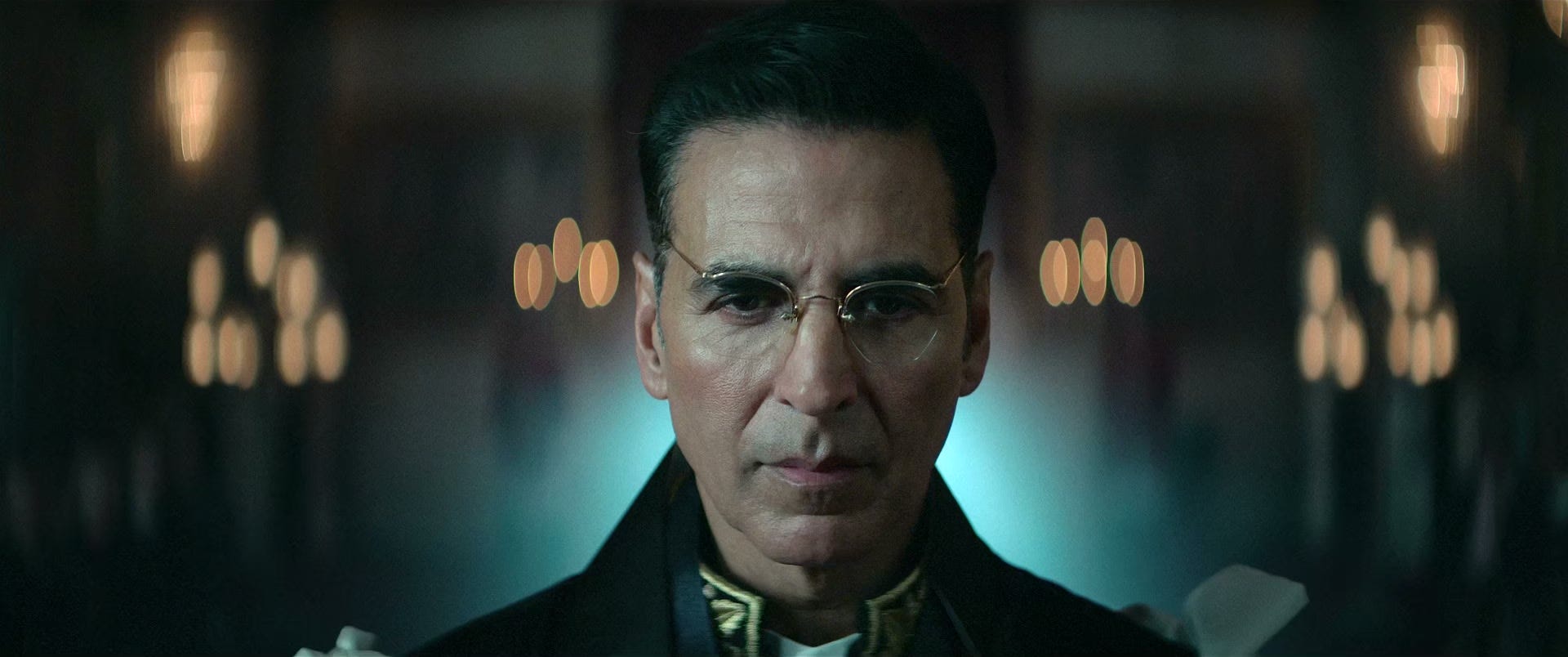
Kesari Chapter 2 is his first feature as director, co-written with Amritpal Singh Bindra. It tells the story of Sankaran Nair, an Indian lawyer knighted by the British crown who turned against the empire, wrote a book arguing that Jallianwala Bagh was a premeditated massacre followed by a coordinated cover-up, and was sued for defamation. The trial became his opportunity to prove, in open court, that everything he had written was true.
Research doesn’t end when you have enough facts. It ends when you know what you think.
Karan and Amrit spent months inside the material before writing a word. They read Kim Wagner’s book on Amritsar, Kishwar Desai’s work, and The Case that Shook the Empire written by Sankaran Nair’s great-grandson Raghu Palat and his wife, Pushpa Palat.
But volume of research was not what unlocked the screenplay. What unlocked it was arriving at a specific, arguable conclusion. The massacre was planned. Troops were called in from outside Amritsar. The Sikh infantry was kept in the dark. A plane flew over Jallianwala Bagh to confirm enough people had assembled. And in the aftermath, the British went into overdrive claiming the crowd had been armed, building a false narrative on top of a deliberate act of mass killing.
“When we came across this research, it was shocking, it was appalling,” Karan says. “Because at once, what you are doing is committing a conspiracy to kill. And then on the other hand, what you’re doing is spreading fake news.”
That was the perspective. Only after locking it in did they start writing.
The courtroom format emerged directly from this logic. Sankaran Nair had been sued for defamation, and his only legal defense was to prove in court that everything he had written was true. The format and the argument were inseparable. And what made this feel urgent rather than merely historical was recognizing that the same mechanics were alive in the present. Fake witnesses. Suppression of inconvenient truth. The manufacture of an alternative narrative after an act of violence.
“Then this became a movie,” he says. “Not just about a past incident. It kind of also spoke to the present.”
Adapting real people: paint, don’t photograph
Karan reached for a principle he credits to Aaron Sorkin, articulated during the writing of Steve Jobs. When you adapt a real person’s life, it need not be a photograph of them or of that time. What it should be is a painting, where you understand the soul, the essence of that person, and paint according to what you want to say through their life.
For Sankaran Nair, that meant identifying the single defining tension in his biography. A man deeply embedded in the British system, knighted by the crown, serving as Advocate General, who then turned completely and spent his public life arguing that the empire was guilty of mass murder. The arc from loyal servant to its most articulate opponent is not just political. It is existential.
Karan found the hinge for that arc in a Pablo Neruda quote he came across during research: Empires perish because they listened to their lawyers and bureaucrats and not to their poets.
“That one thought became Sankaran Nair’s arc,” Karan says. “He goes from being a lawyer-bureaucrat, a servant of the British empire, into becoming a poet. And when I say poet, I mean a revolutionary.”
In the first act, Sankaran Nair sends a poet to jail, defending the decision with the logic of pragmatism. What a country needs is not revolution but infrastructure, the ability to speak the colonizer’s language. It is a reasonable man’s argument, and the film treats it as such. The poet’s son Pargat becomes the moral center who presses on that logic throughout, not defeating it in debate but embodying its cost. Karan also spent considerable time in conversation with Sankaran Nair’s great-grandson Raghu Palat and his wife, giving the character work a foundation that pure archival research alone could not have provided.
Collaboration is a method, not just an arrangement
Karan is skeptical of filmmakers who use the word “I” when describing their work. He looks down on people who say “I came up with this” as though a film is a solo act.
What he describes about co-writing with Amrit is not a smooth creative partnership. It is a marketplace of ideas — arguments, debates, and bickering that eventually produce truth. “In this debate, in this discussion, something beautiful emerges,” he says. “Eventually you will arrive at a good scene.”
That pressure extended onto the set. The washroom scene was written without dialogue. Sankaran Nair walks into the space he was once barred from, the two men look at each other, and the scene cuts. Akshay Kumar kept telling Karan and Amrit this was not enough. He kept pushing. They resisted. He kept pushing. Eventually came the line: the empire is shrinking. Delivered in the very washroom where the board had once read Dogs and Indians Not Allowed. “When we shot that scene,” Karan says, “we were 101 percent sure that this is gonna make the trailer.” It did.
The water glass scene moved differently. The script had R. Madhavan’s character offer a glass of water to a terrified British witness before her testimony, theater designed to manage the jury’s perception. When the same witness later broke down under cross-examination, Kumar added something unscripted: he walked over and handed her his handkerchief. A second gesture of theatrical courtesy offered to a witness his character had just destroyed, aimed at his adversary across the room. No line. No direction. An actor so inside the scene he found a beat the writers had not written.
The director’s job is not to protect the script from the actors. It is to create the conditions in which better ideas than your own can emerge, and to recognize them when they do.
Solving the courtroom exposition problem
Courtroom drama lives and dies on information. Done wrong, you end up with actors delivering speeches at each other. Karan studied Aaron Sorkin’s Trial of the Chicago 7 and A Few Good Men specifically as reference points for making legal argument feel alive.
His first line of defense was the dialogue team. Sumit Arora and Akshat Ghildial wrote Hindi dialogues specifically designed to stay character-driven rather than informational. His second was visual intercutting, built into the screenplay from the start. When Sankaran Nair invokes Dyer’s childhood in cross-examination, the film cuts there. The argument becomes visual, felt rather than merely heard. Editor Nitin Baid shaped exactly when to cut and when to stay, and music by Shashwat Sachdev built the atmosphere the courtroom scenes required.
The information in a courtroom scene needs to carry feeling, not just argument. The moment the audience is tracking facts rather than feeling something about those facts, the scene is already losing them.
How a director talks to a cinematographer
Karan brought cinematographer Debojeet Ray onto the project early enough that Debojeet read an English draft before any shot had been designed. Their first reference film was Richard Attenborough’s Gandhi — not to borrow its look, but to study how it worked. The Jallianwala Bagh sequence is chaotic and brutal, and then Attenborough cuts immediately to a profile closeup of General Dyer framed against the British flag, in complete silence. They sat with that cut, understanding what a single compositional choice could carry. They also watched Sidney Lumet’s The Verdict and Pablo Larraín’s Spencer, not for their visual language but for how each director was thinking.
The working method was built around one question Karan returned to with every department: what is the emotional core of this scene? He would explain one thought, then step back. Once Debojeet understood the emotional core, Karan’s job was to leave him to find the image.
The film’s most delicate scene is when Sankaran Nair reads the poet’s letter and cries for the first time. Karan’s direction was defined almost entirely by restraint. No visual gimmicks. No intercutting. Let the letter carry the weight. The one addition was a fire burning in the background, and it was Debojeet’s idea to catch the reflection of the flames in Sankaran Nair’s eyes in the final closeup. One image, arrived at collaboratively, that made the metaphor of the torch of revolution visible without explaining it.
“It’s some magic that was created,” Karan says. “With everybody understanding the emotional core. A great actor, a great DOP, keeping it simple, and understanding that the real core of the scene is about passing the torch of revolution.”
The want-versus-need architecture of Sankaran Nair’s character resolves here. He wants to win the case. He needs to understand that revolution and poetry are what actually bring about change. It is the poet’s letter that moves him from one to the other and makes the climax possible.
On not letting go
When asked whether he can detach himself from the film now that it belongs to an audience, Karan does not reach for a composed answer.
“If I’m being absolutely honest, this is also my first film. I’m obsessively attached to this film. I love it to death. I love it as a parent would love their child. Any negative response really hurts me. I read everything.”
He is not sure he is supposed to feel this way. Maybe, he says, he still has to grow up to understand how other directors detach. But he is not convinced he wants to. The clapperboard he held on Rangoon was a year of being in the room where it happens, watching Bhardwaj think through decisions, watching a script become a scene under pressure. He was supposed to disappear into the work. He did. And everything he absorbed in that invisibility is present in Kesari Chapter 2.
Kesari Chapter 2 is written and directed by Karan Singh Tyagi. This conversation was recorded for the Invisible Storytelling podcast. Subscribe below for more craft breakdowns from the show.