

Jeff Cronenweth keeps a mental library. Not of shots he has done, but of problems he has solved, and the cinematographers he watched solve them before him. His father Jordan shot Blade Runner. His grandmother was a Busby Berkeley dance girl. Film was never a career choice. It was the water he grew up in.
He assisted for years before shooting. Seven films with Sven Nykvist, Bergman’s long-time collaborator. Watching someone navigate Swedish winters and close faces with an economy that only comes from having shot the same human condition two dozen different ways. When Fincher eventually handed him Fight Club, Cronenweth had already spent years in rooms where the decisions were being made.
He never stopped absorbing.
Research your collaborator the way you research the material
When Mark Romanek called about Tales from the Loop, what made it right was not just the story. It was the timing, the production, and a working relationship that went back to One Hour Photo. They had a shared language already built.
That matters because the deeper the trust, the more honest the debate. And it is the debate that produces the work. On Tales from the Loop, they spent nearly five weeks in pre-production, longer than most television schedules allow, designing the visual language for the entire series before a single frame was shot.
They started with Simon Stålenhag’s paintings. Beautiful as standalone images. Heavily saturated, pushed color, striking. But they would not carry eight episodes of grounded human drama. So they went to Bergman. Kieslowski. Tarkovsky. Not to reproduce their images, but to understand how those directors were thinking about restraint. About letting performances breathe inside a frame rather than compete with it.
Find your references early. Go deep on why they work. Then leave them behind. The goal is to internalize a way of thinking, not copy a look.
Isolation is a technical problem with an emotional answer
Tales from the Loop required something specific that Cronenweth solved at the equipment level. The show follows children navigating a quietly strange world. The visual language needed to make them feel small without making them feel lost.
He shot on a RED Monstro in 6K with 70mm glass, wide open, on a larger sensor. The shallow depth of field was deliberate. Disorienting. Placing children inside an epic landscape with just enough background visible to feel the scale. Not a tight closeup on a long lens, which would isolate purely. Something slightly wider that kept the world present while the character remained vulnerable inside it.
“This little girl who’s looking for her mother can feel more isolated in this world,” he says. “It’s more confusing and disoriented not to be able to see where she is. It’s more like being alone and afraid.”
The equipment choice was made before a single location was scouted. The feeling came first. Everything followed.
Two cameras on opposing angles is not a compromise
The opening sequence of The Social Network is eight pages of dialogue. Two people constantly talking over each other. Cronenweth solved it with two cameras shooting crossing angles simultaneously on every pass. A wider crossing and a tighter crossing. So that each take gave the editor a cutting point at any moment in the performance.
Traditional coverage would have locked them into matching problems. The dialogue was too fast, too layered, too dependent on the specific energy of each take. One side at a time would have broken the scene entirely.
What the crossing setup gave them was freedom inside the chaos. Every line. Every interruption. Every overlap on film from both directions at once.
The principle generalizes. When the writing has its own rhythm, the camera’s job is to protect it. Coverage should serve the dialogue’s demands, not the cinematographer’s preference for clean setups.
Cronenweth also points to something Fincher did in the mix. The scene opens at full bar noise volume. The audience instinctively leans forward to hear. By the time the mix drops, the lean is already committed. “Once I get you leaning forward, you’re not gonna sit back until this thing’s over.”
The difference between a good shot and one people remember twenty years later
Cronenweth is specific about what makes an image stick. It is never one department. It is every department arriving at the same moment.
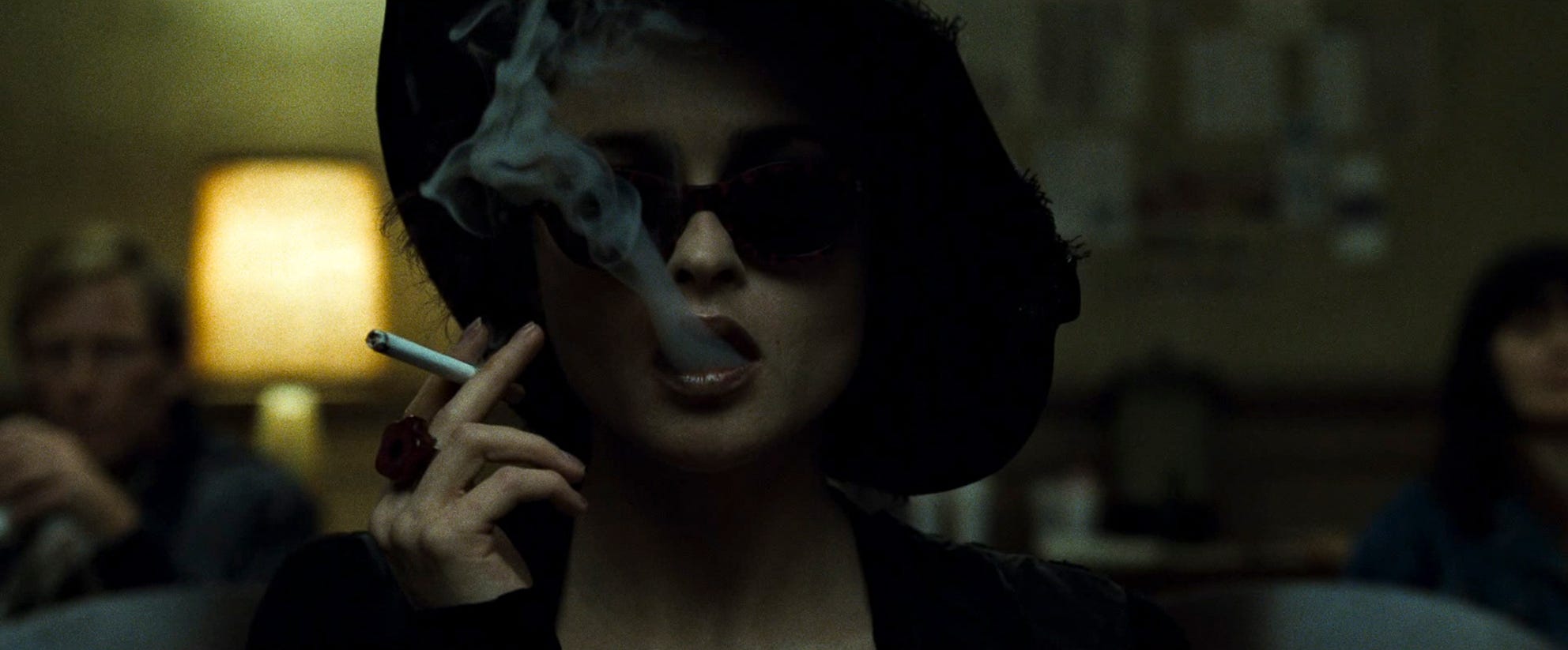
The Helena Bonham Carter closeup in Fight Club is the example he keeps returning to. She is in the back of a support group she has no business attending. Black hat. Cigarette. A quality of light that felt, to him, like Rachel being interrogated in Blade Runner. Not because he copied it. Because something in the composition landed in the same emotional register. “For me, it’s one of the prettiest closeups I’ve done. She looked so badass and cool.”
The Gone Girl shots came from a different logic. Amy’s character has two visual phases, and Cronenweth treated them as separate films. Before the reveal, softer lensing, a slightly more sympathetic framing. After, something more mischievous. More predatory. Same actress, same locations, different visual contract with the audience. The bathtub shot, the motel room with the television. “We were just kind of creeping up on her.” The camera’s relationship to a character can change what the audience feels about them before a word is spoken.
The IKEA sequence in Fight Club worked because the previs existed. They could see what the shot was going to say before they built it. “It just hit home so much. It was so culturally right at the time.” Knowing that ahead of the shoot let them commit to it completely rather than hedge.
The pattern across all three: iconic images are not accidents and they are not solely the cinematographer’s invention. They are the result of a clear idea, held by everyone in the room, executed without compromise.
Motivated light is a contract with the audience
On Tales from the Loop, Romanek initially wanted something bold. An unjustified, entirely foreign light source as the primary source throughout. No explanation. No practical motivation. A constant presence that answered to nothing.
It worked as a concept. It did not survive contact with domestic spaces. Bedrooms, kitchens, classrooms. A constant overhead source that belonged nowhere started to feel forced. It created a presence the audience would track rather than forget. In a show built on grounded emotional stories, anything pulling focus from performance was working against the material.
They kept it organic. Practical sources. Motivated light. Not because the rule demanded it. Because the story did.
“There’s enough kooky stuff going on,” he says. “To have kooky light sources on top would convolute the story.”
Lighting style is a choice about where you want attention. Unmotivated sources announce themselves. When the story is the point, the light should disappear into it.
Fight for every shot, including the ones that feel impossible
On Dragon Tattoo, Cronenweth had 156 shooting days. If a scene got away from him, there were 155 more chances to recover. Television does not offer that.
The shift is not about lowering standards. It is about a methodology that meets the schedule without conceding the work. Two-camera setups wherever possible. Efficient blocking. An eye on the whole day, not just the current setup.
But within that efficiency, he is emphatic. Fight for every shot. The math is simple and unforgiving. Ten shots a day for a hundred days. Let one go each day and that is a hundred shots at the end of the film that are not what they should have been. Twenty or thirty minutes of your movie, just below the standard you set for everything else.
“There’ll be plenty of shots you wish you could have changed later anyway,” he says. “But try to fight for all of them.”
Fear is an engine, not a flaw
When Fincher was finishing Fight Club, he told Cronenweth it would probably be the best script he ever directed, the best performances Pitt and Norton would give, and probably would not make money. They both knew they were making something that could not be marketed conventionally. The irreverence was the point. The fighting was never about fighting.
The marketing went a different direction. Fight Club came out and did not perform. Then it hit DVD and went to number one. Then it became one of the most studied films of its generation.
Cronenweth talks about this with equanimity. But what stands out is not the vindication. It is what he learned from his father during Blade Runner. The calls at the end of each day, asking whether the shadows were too deep, whether there was enough light in the eyes. Cronenweth calls these the exposure trauma conversations. He never missed one.
That sustained anxiety, he says, is not a weakness. It is what kept both of them from getting comfortable. From reproducing what worked instead of pushing past it.
“Fear keeps you on edge,” he says. “It stops you from falling in love with your own style or getting mediocre. Embrace it. It keeps you progressive.”
His father called at the end of each shoot, worried about the same darkness that made Blade Runner immortal. Then went back and pushed it further the next morning.
On not giving up the basics
Study continuity as if it is mandatory. For anyone who has worked with Fincher, it is.
Light cannot shift sides between setups without reason. Coverage has to be thought through before it is shot. Block the scene first. Find where everyone will be. Light it for where the coverage will need to go. Then adapt.
“After time, you think about all those things ahead of time,” he says. “I’m going to light from this side because that’s going to be a problem later.”
The instinct to plan for problems you have not encountered yet is not innate. It accumulates from watching veteran crew members solve things quickly. From recognizing that someone on set has seen this before. The knowledge lives in the room. Staying open to receiving it is its own skill.
This conversation was recorded in 2020 for the Invisible Storytelling podcast. Subscribe below for more craft breakdowns from the show.