

Erik Messerschmidt grew up on the coast of Maine building things and taking them apart. He was a theater kid who loved stagecraft. A musician who was not good enough to keep going. A still photographer before he was a filmmaker. None of it pointed obviously toward cinema. All of it did.
What drew him to film school was not movies. It was a film set. The energy of it. The collaboration. The way it combined science and art and the feeling of playing in an orchestra, everyone working toward the same thing at the same time. He wanted to be on the biggest sets he could find, not to shoot them but just to be inside that mechanism.
He came up through the grip and electric departments. Spent years as a gaffer, working for cinematographers he admired, learning what was being asked of people and whether it was reasonable. He never wanted to be the person who bluffed their way through a conversation about craft because they had skipped the steps. He did not skip the steps.
By the time David Fincher handed him Mindhunter, Messerschmidt had spent years in rooms where the decisions were being made. He had learned to check his ego at the door before he even knew that was the thing he was learning.
Light follows the camera, not the other way around
Messerschmidt’s first principle of lighting is not about light at all. It is about where the camera is going.
In theater, the audience never moves. You light for one point of view and you can be as deliberate as you like about it. Cinema constantly moves the audience’s perspective around the room. A scene lit beautifully from the front can fall apart the moment the director decides to shoot from the other side. Everything you planned is suddenly wrong.
The consequence is that every lighting decision has to start with the camera direction. Where are we going to put the camera? How many positions do we need in this space? What does the light need to do in each of them? Only after those questions are answered does the actual work of lighting begin.
“Something can go from front lit to back lit just because the director changes their mind and wants to shoot from the other side,” he says. “All your entire plan is suddenly out the window.”
The cinematographer who starts from a lighting position and forces the camera to work around it is, in his words, wagging the dog. It never works. The camera tells the light where to go, not the other way around.
Testing is not a technical formality
Between the first and second seasons of Mindhunter, Messerschmidt and his colorist spent four months doing nothing but testing. The show was doing an HDR finish he had not done before. He wanted to understand exactly where every decision would land before he made it on set.
Most producers resist this. They feel that modern digital cameras give you enough visibility into what you are getting. He thinks that is exactly wrong. The color pipeline, the camera capture technology, the lensing, the projection, the finishing — all of it is dynamic and shifting fast. If you do not test, you are making decisions without knowing where they will resolve.
What the four months of testing gave him was not just technical knowledge. It was confidence. On set, if he wanted to push something very dark or blow a window very bright, he knew empirically where it would fall in the grade. He could have a real conversation with the makeup artist about lipstick. He could look at a striped dress and tell the costume designer exactly how it would resolve on screen.
“It gave me so much confidence on the set,” he says. “I knew if I wanted to take something really dark, I knew where it would fall.”
The information is only available if you have done the work to get it. The testing process is how you earn the right to make bold decisions without guessing.
The Manson scene: photographing what happens between the words
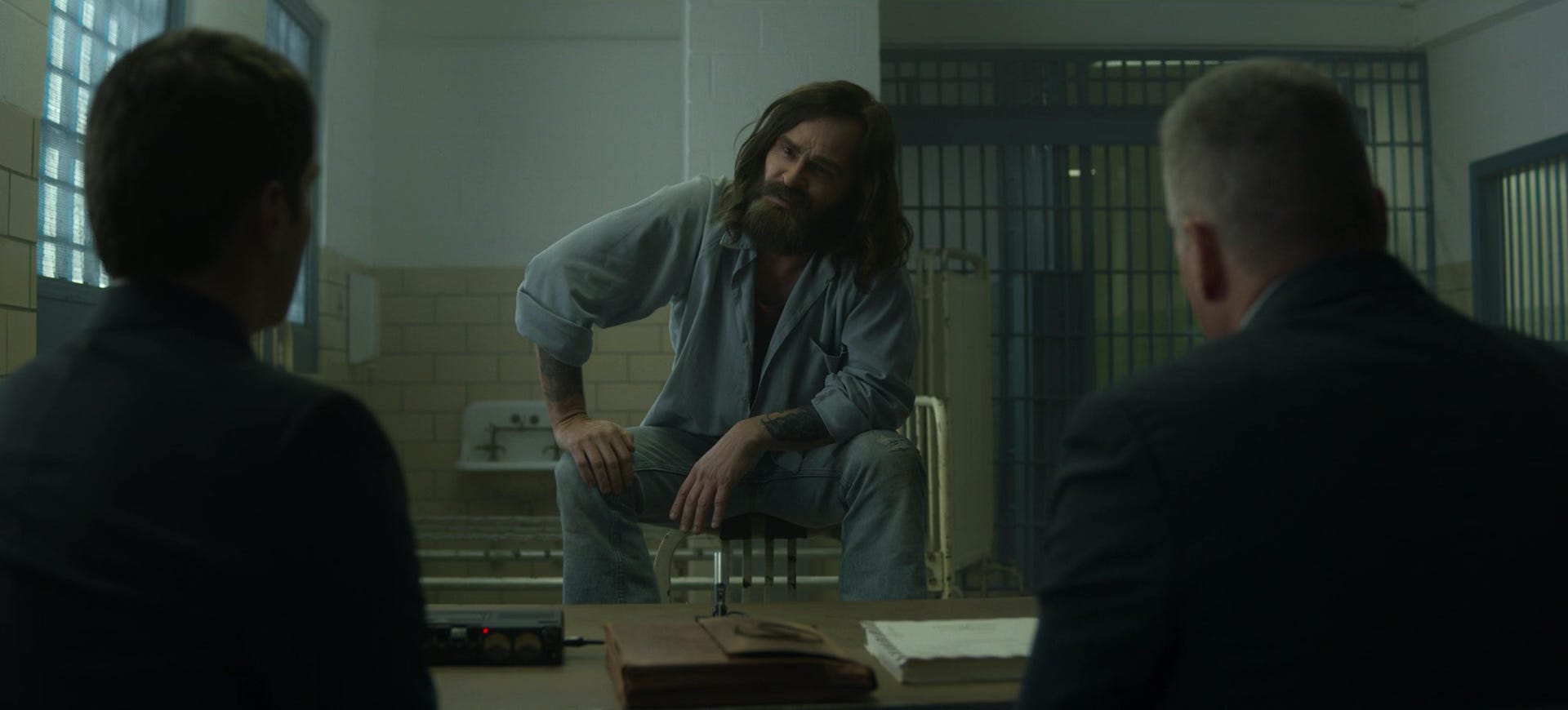
Season two of Mindhunter, episode five. Holden and Bill meet Charles Manson. Real footage of that interview exists. The scene had to earn its existence.
What made it possible was rehearsal. Mindhunter had producers who understood its value and supported it. Director Andrew Dominik worked the scene with the actors until the power dynamics were not just written but physically embodied. When Manson enters and Holden stands involuntarily while Bill stays seated and aggressive — that did not come from the script alone. It came from actors and a director spending enough time with a scene to find what it actually was.
Messerschmidt’s job was to watch. Run the scene. Watch it again from every possible angle. Find the moments between the words, the exchange of looks, the posture shifts, the things happening in the margins of the written action that the actors were doing naturally or had worked out themselves. If those moments are not photographed, the audience never sees them.
“If we don’t photograph it, the audience never sees that stuff,” he says.
Once he had watched enough to know where those moments lived, the camera choices became almost obvious. A wide lens here to extend the distance. A two shot there because the dynamic needs to be felt between two people in the same frame. A hard cut to Holden’s face because that is the one moment the audience needs to be inside his infatuation. The mechanism of filmmaking applied to beats the rehearsal process had already surfaced.
His favorite part of the job is exactly this. You know what you need to sell. Now you find the fifteen ways to sell it, shoot seven of them, and let the director and editor find the one that works.
The temptation of black and white
Mank was Messerschmidt’s first black and white feature. He describes the experience with the slightly stunned quality of someone who came close to a dangerous edge and got out.
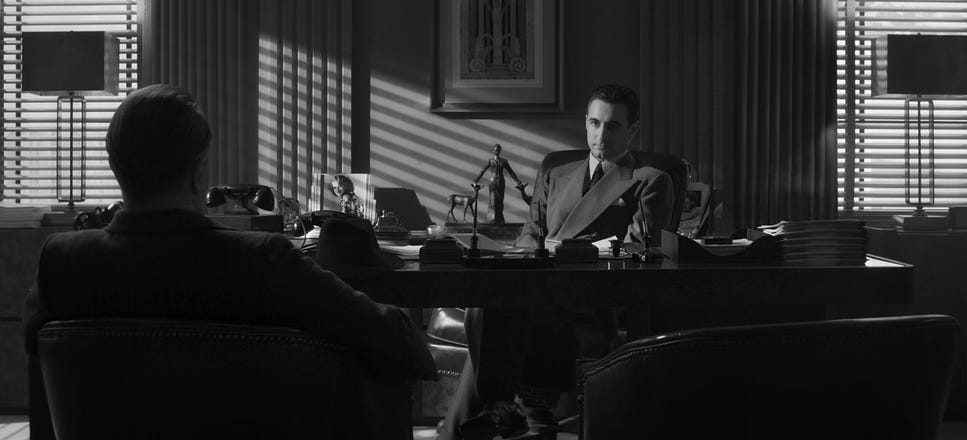
In color photography, color itself does tonal separation. Layers of hue can trick the eye, create depth, assist composition. In black and white, that tool is gone. You are left with tonal separation in gray and the use of focus. Compositions that would be too aggressive in color become available. Hard light through venetian blinds. Heavy foreground shadows. Strong structural choices that color would make feel overwrought.
“Cinematographers look at black and white and go, great, I get to throw hard light through some venetian blinds,” he says. “And you have to be really careful.”
The danger is that the medium seduces you into making choices that the scene cannot support. The visual grammar of black and white is forgiving. The audience will accept more stylization than they will in color. But that forgiveness runs in both directions. A choice that the set makes available, the architecture offers it, the light suggests it, may not be what the story actually needs. You can end up making the film look exactly right while pointing it in the wrong direction.
His check against this was the same question he asks on every project. What are we trying to give the audience here? Not: what can I get away with in this medium?
On taking responsibility for your choices
Messerschmidt is particular about the word control when applied to his relationship with post-production. He replaces it with participate.
It is the director’s film. It is the producer’s film. His job is to make sure his opinion is heard, to be present all the way through to delivery, and to accept that the final decision is not his. He has been in QC sessions at networks. He has watched cuts and flagged performances the editor may not have seen. He does not require being right. He requires being part of the conversation.
The same principle applies to everything. Decisions on set are his to make. The responsibility for them is also his. He has shot things that had to be reshot because he made a mistake. He says so plainly. Too dark. Too saturated. Doesn’t work.
“I’ve shot stuff that we’ve had to reshoot because I’ve made mistakes. It’s healthy to go and say, yeah, I fucked that up.”
He believes this is what a functional set runs on. Not confidence that every choice is right, but the willingness to own every choice you make and to say openly when one was wrong. The environment breaks down when people make decisions they are not prepared to take responsibility for. The work gets worse. The trust evaporates.
He has an Instagram bio that reads: it’s not dark. It’s rich.
He says it is tongue in cheek. Everything else in how he talks about the job suggests he means it completely.
This conversation was recorded in 2020 for the Invisible Storytelling podcast. Subscribe below for more craft breakdowns from the show.